
Imagined Muse
Updated: Apr 14
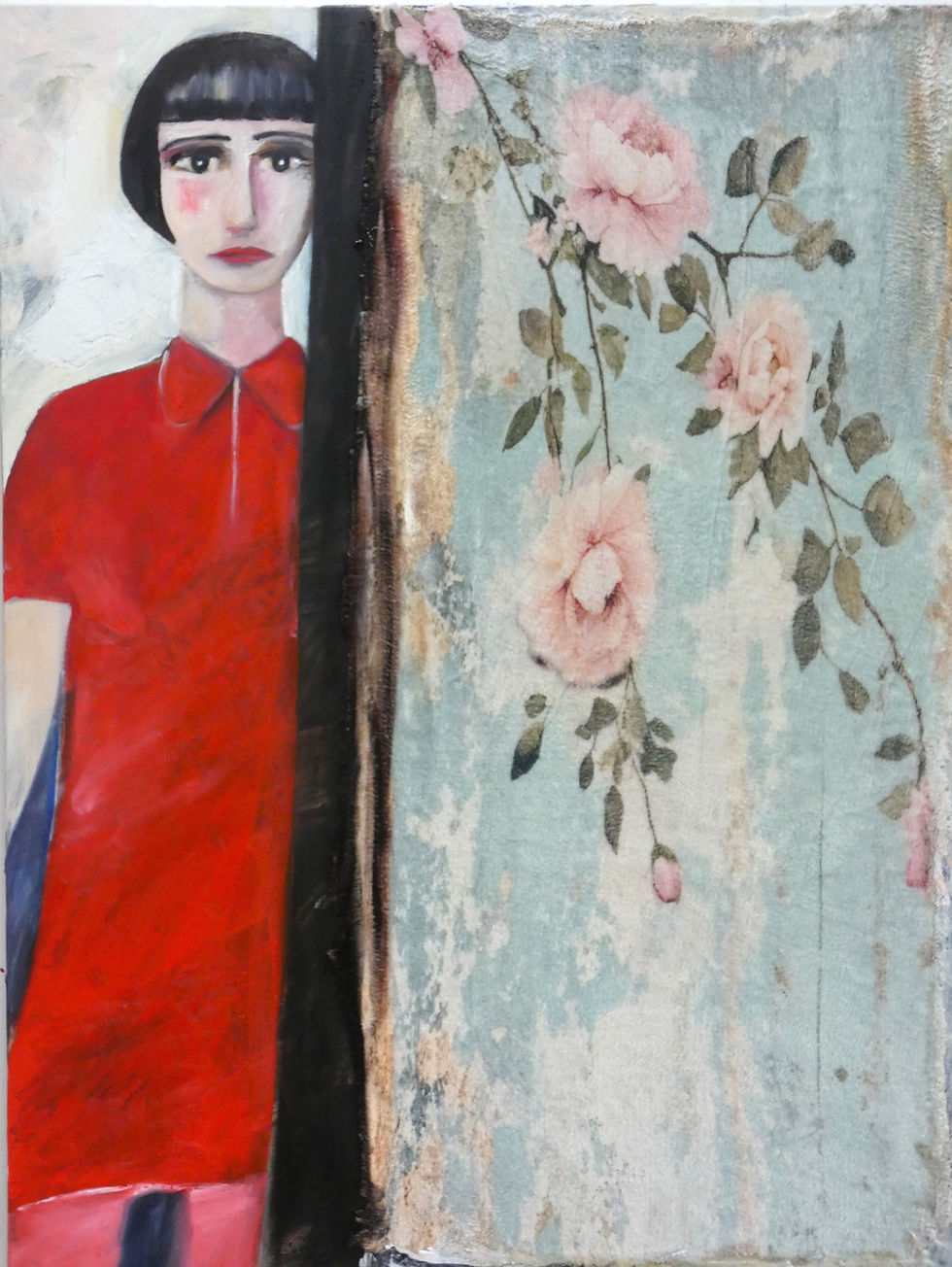
I am very grateful to my imagined muse. We have had many adventures together.
When, thirty years ago, I took up a rag and some oil paint and took hold of a small ready-stretched canvas with no clear intention, the image that presented itself was that of a head and shoulders akin to silent movie star Louise Brooks. Little did I know this image would remain with me as a kind of talisman , go-to image, and source of problem making and problem solving for years to come.
When I was younger I could never quite see why painting was a problem. That was something my tutors spoke about. "Solving problems". Only now do I see that the very act of taking up an oily rag and a blank canvas is the very act of creating a problem with which to solve. The act of picture making, the essence of what Picasso called the "sum of destructions".

My muse doesn't always attain the same face, should I see them as sisters? The intention is the thing, the configuration which drives forward the gathering of attributes, the construction of the puzzle to be solved. Sometimes the constructed image comes fast, simply falls into place. At other times the muse demands some work and the act of destruction can go on for some days. The face as image carries the activity forward. It is like giving life to the blank canvas.

Is this akin to the film director focusing his camera upon his favoured female protagonist? I am put in mind of Antonioni's Monica Vitti in the film L'Avventura, the classic art house film in which little happens. Also I cannot help thinking of Last Year at Marienbad (L’Année Dernière à Marienbad, Alain Resnais, 1961) in which the camera constructs a game of images, prompting the link between a man, woman, a palatial hotel, it's garden , it's antique sculptures, it's inside and outside. On the part of the screenwriter the pen, initially, must surely have had the same action as my oily rag.

The movement of 'A' (Delphine Seyrig) around the environment of Marienbad (which turns out in reality to be the Nymphenburg Palace in Munich) reminds me of the female protagonist portrayed on a thousand paperback romances, the heroine running away from or exploring with flickering candles, the old dark house, be it castle or other spectral edifice.
She is derived from the Gothic novel of course, we have Ann Radcliffe (1764-1823) to thank for such a dreamscape. The castle of Udoltho (The Mysteries of Udoltho pub.1794) casts a shadow over the surrealists, even perhaps over Sade, who may or may not have been influenced by the English woman's novel.
(January 2026)



Comments